

Most budgets don’t fail because someone lacked willpower. They fail because a piece was missing, like the car registration nobody planned for or a grocery line that was really a guess.
Building a budget from scratch takes a handful of steps, from finding your take-home pay to tracking what you spend, and making your first budget walks through each one. This article picks up after that, with the parts that decide whether the plan keeps working.
Below are the eight key components of successful budgeting, a quick way to check yours, and the methods and tools that make the work easier. None of it requires a finance degree, just honest numbers and a few minutes a week.
What Makes a Budget Successful?
A budget is a plan for your money over a set period, usually a month. It compares what comes in with what goes out, then decides ahead of time where each dollar should go.
At its core, every budget has two major components: income and expenses. Everything else in this article is a way of making those two numbers honest, planned and checked.
So what separates a successful budget from one that gets abandoned in February? A successful one is a plan you can actually follow, because it covers your real costs and leaves room for the things you care about.
It also produces positive cash flow, meaning more money comes in each month than goes out. That’s the simplest test there is: if your accounts keep shrinking while the budget says you’re fine, some component is missing or wrong.
The 8 Key Components of Successful Budgeting
Think of these as parts of one machine rather than items on a checklist. Income sets the limit, expenses and goals compete for that limit, and tracking tells you when something needs to change.
1. An Accurate Take-Home Income Figure
Your budget starts with the money you can actually spend. That’s your take-home pay after taxes, insurance and retirement deductions, not the salary on your offer letter.

Using gross pay is one of the fastest ways to build a plan that comes up short every single month. Pull your last few pay stubs and use the net amount instead.
If you’re paid every two weeks, remember that two months a year bring a third paycheck. Budget on two paychecks a month and treat the extra one as a boost for your goals.
Income that changes takes more care. If your wage depends on hours, tips or freelance work, look at the last several months and build the plan around a lower-than-average month, not your best one.
Here’s a hypothetical example. Say your last six months of take-home pay ranged from $2,900 to $4,100; planning on $3,000 means a strong month gives you extra to save instead of a weak month leaving a hole.
The same caution applies to passive income, like interest from a savings account. Count it once it reliably arrives, not before.
2. A Complete List of Fixed and Variable Expenses
Expenses come in two kinds. Fixed expenses stay about the same each month, like rent, insurance, a car payment or a phone plan, while variable expenses change, like groceries, gas, utility bills and eating out.
Fixed costs are easy to list because they show up on your statements the same way every month, and some of them, like insurance and phone plans, are worth shopping around once a year. Variable ones are where budgets usually go wrong, because people tend to guess low.
The fix is to look backward before you plan forward. Go through two or three months of bank and card statements, sort every charge into a category, and use the real averages.
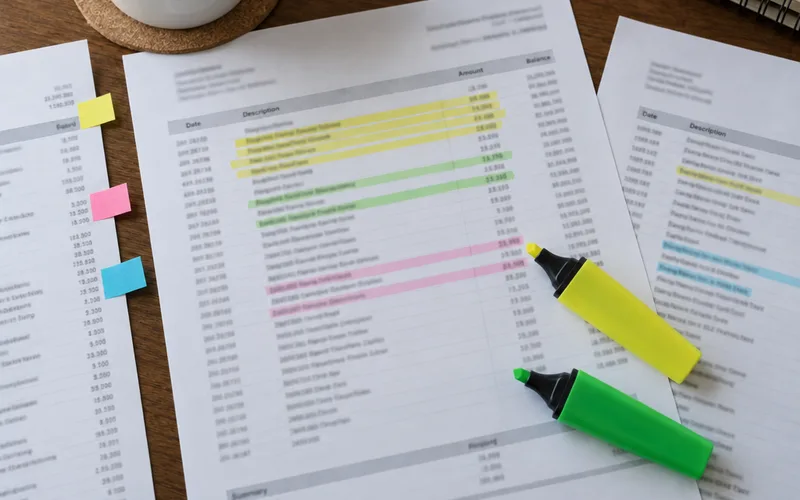
You’ll probably find a few surprises, like a subscription you forgot about or a grocery total well above your guess. Those surprises are exactly what a working budget needs to know, and they often point to where you have room to cut.
Typical figures can also help you set a fair starting point. A realistic food budget gives you a benchmark for groceries, and average entertainment costs show whether your fun spending is quietly crowding out other goals.
3. Room for Irregular and Yearly Costs
This is the component most budgets leave out. Car registration, holiday gifts, annual subscriptions, back-to-school shopping and yearly insurance premiums don’t arrive monthly, so they’re easy to forget until the bill shows up.
When it does, the money usually comes out of the grocery line or goes on a credit card. The budget feels broken, but it really just never planned for a cost everyone knew was coming.
That’s where a sinking fund comes in. It’s a small monthly amount you save toward a known future expense, so the bill is covered before it arrives.
Here’s how the math works. If your car registration costs $240 a year, setting aside $20 a month means that bill is already paid for when the notice lands in your mailbox.
Start by listing every irregular cost from the past year, divide each one by 12, and add those amounts as monthly lines. Setting up sinking funds can be as simple as one savings account plus a spreadsheet that tracks each pot.
4. Clear Goals With Numbers and Dates
Without goals, a budget feels like a list of things you’re not allowed to have. With them, every limit has a reason behind it.
Good goals are specific. “Save more” is a wish, while “$1,500 for a car repair fund by June” tells you exactly how much to set aside each month.
The budgeting app YNAB builds its approach around one question, “What’s it for?”, and asks you to plan what your money should do before you spend any of it. That question works with any budget, whether you use an app, a spreadsheet or a notebook.

Mix short-term goals, like an emergency cushion or a trip, with long-term ones, like a down payment or retirement. If you’re juggling several at once, saving for different goals gets easier when each one has its own line and its own deadline.
5. Spending Limits You Can Live With
A budget that’s too strict tends to last about as long as a crash diet. If you cut dining out from $400 to zero overnight, you’ll likely blow past the limit and give up on the whole plan.
A better approach is to set limits close to what you spend now, then trim gradually. Dropping that $400 to $300 for a month, then to $250, gives you a target you can hit and a habit that actually sticks.
Leave a line for fun too, even if most of it goes to cheap date nights and coffee with friends. A small guilt-free spending line is often what keeps people from walking away from the plan entirely.
A rule of thumb can help you set those limits. The 50/30/20 rule puts about 50% of take-home pay toward needs, 30% toward wants and 20% toward savings and extra debt payments.
Variations shift those shares to fit different lives. The 70/20/10 rule gives more room to living costs, which helps when housing takes a bigger bite of your income.
6. Savings That Comes First
If savings only gets what’s left at the end of the month, it usually gets nothing. A successful budget treats savings like a bill and pays it first, ideally with an automatic transfer on payday.
The first job for that money is an emergency fund. Over time you’ll want it to cover several months of essential expenses, but even a starter cushion of a few hundred dollars keeps a flat tire from landing on a credit card.

Once that cushion exists, savings can move toward bigger goals like a down payment or retirement. The amount matters less than the habit, because a $25 transfer you never skip beats a $200 plan you abandon.
7. A Plan for Debt
Debt payments belong inside the budget, not outside it. Start by listing every balance with its interest rate and minimum payment, then make sure every minimum is covered.
Any extra money goes to one target debt at a time. The snowball method pays the smallest balance first for quick wins, while the avalanche method targets the highest interest rate first and usually costs less overall.
Which one is better? Usually the one you’ll stick with, since both work when the extra payment keeps showing up.
A short, focused payoff plan, like getting debt-free in six months, only works when your budget shows exactly where that extra payment comes from. That’s why the debt line and the spending limits have to be built together.
8. Regular Tracking and Check-Ins
A budget you never look at stops matching your life within a few weeks. Tracking means comparing what you planned with what you actually spent, category by category.

Daily tracking isn’t necessary for most people. A quick weekly look catches overspending while there’s still time to adjust, and a longer monthly review is where you change the plan itself.
A few simple metrics make those reviews faster:
- Planned vs. actual: how far each category landed from its limit
- Savings rate: the share of take-home pay that went to savings
- Month-end cash flow: whether your balances grew or shrank
Those metrics tell you more than a feeling about whether the month went well. When the same category runs over every month, either the limit was unrealistic or the spending itself needs attention, and these ideas on how to stop overspending focus on the habits behind it.
How to Check Whether Your Budget Has Every Component
You can run this check in about ten minutes with your budget and last month’s statements. Go down the list and answer each question honestly:
| Component | Ask yourself | It’s working if |
|---|---|---|
| Income | Is it take-home pay? | You plan on net, not gross |
| Expenses | Did I use real averages? | Few charges surprise you |
| Irregular costs | Are yearly bills listed? | Annual bills are prefunded |
| Goals | Does each have an amount and date? | You know the monthly target |
| Spending limits | Did I hit them last month? | Most lines land close |
| Savings | Does it move on payday? | The transfer is automatic |
| Debt | Is every minimum covered? | Balances shrink each month |
| Tracking | Did I review last month? | You check in weekly |
Any “no” points straight to the component to fix first. Most people find one or two gaps, and fixing those usually does more good than starting over with a brand-new system.
Choosing a Budgeting Method That Fits
The components stay the same no matter which method you pick. The method is simply the system you use to divide the money.
Zero-based budgeting gives every dollar a job. Ramsey Solutions’ EveryDollar app defines it as planning where every dollar goes before you spend it, so your income minus expenses equals zero.
That doesn’t mean spending everything; savings and debt payments count as jobs too. A zero-based budget template makes the math easier to set up the first time.
The 50/30/20 rule splits take-home pay into needs, wants and savings. It’s quick to set up and works well if you want guardrails without tracking every small category.
The envelope method assigns a fixed amount of cash to each spending category, and when an envelope is empty, that category is done for the month. A cashless envelope system applies the same idea with digital categories or separate accounts.
Pay yourself first moves savings out on payday and lets you spend the rest freely. It suits people who dislike detailed tracking but still want steady progress.
Not sure which to choose? Start with the method that asks the least of you, because a simple system you follow beats a detailed one you drop by spring.
Tools That Keep the Components Running
You can run a budget on paper, in a spreadsheet or in an app. The tool matters less than whether it makes tracking easy enough that you keep doing it.
Paper and spreadsheets are free and flexible, and they make you look at every number. Apps and budgeting software save time by importing transactions and sorting them into categories for you.

If you go with an app, check the cost and trial terms before you commit. EveryDollar has a free version with no time limit, while its premium plan costs $79.99 billed annually or $17.99 billed monthly after a 14-day free trial.
YNAB offers a free 34-day trial, which is long enough to run one full monthly budget cycle before you pay anything.
You may still see older advice recommending Mint. Intuit says Mint has been reimagined on Credit Karma, which is now where its transaction review and spending tracking live.
Because the lineup keeps changing, compare current budgeting apps side by side before you pick one. Look for the method you chose above, since an app built around a different method will feel like a fight.
Why Budgets Fail and Which Component Is Missing
Most failed budgets trace back to one missing part, not a lack of discipline. Here’s how the most common problems line up with the components above:
- “I always run out before payday.” Income is probably overstated, or variable expenses were guessed low.
- “One big bill wrecked my month.” There’s no sinking fund for irregular costs.
- “I just stopped following it.” Limits were too strict, or there are no goals giving the plan a purpose.
- “I never manage to save anything.” Savings comes last instead of first.
- “I didn’t notice I was over until the month ended.” Tracking happens too rarely.
That’s encouraging, really. Fixing one component is far easier than rebuilding your entire approach to money.
Keeping Your Budget Working Month After Month
A successful budget changes as your life does. A raise, a move, a new baby or a paid-off car all mean last month’s numbers no longer fit.
Build a short monthly routine around three moves: compare planned and actual spending, send whatever is left over toward a goal, and set next month’s limits. Make those changes before the new month starts, not halfway through it.
Give the plan three months before you judge it. The first month is usually messy and the second is better, but by the third your numbers reflect real life instead of guesses.
Frequently Asked Questions
How should I budget my money?
Start with your take-home pay, list your fixed and variable expenses from real statements, and set aside money for savings and irregular bills first. Then set realistic limits for everything else and check your spending each week.
What is the definition of a budget in economics?
In economics, a budget is a plan that sets expected income against planned spending for a specific period. Households, businesses and governments all use one to decide how limited money is divided.
What are the two major components that go into a budget?
The two major components are income and expenses. Income is the money you expect to receive, and expenses are everything it has to cover, from fixed bills to savings and flexible spending.
What are the different types of budgeting methods?
Common methods include zero-based budgeting, the 50/30/20 rule, the envelope method and pay yourself first. Each one divides the same income differently, so pick the one you can follow most consistently.
What is the key to a successful budget?
The key is realistic numbers plus regular check-ins. A budget built on your actual spending and reviewed at least monthly can adjust before small problems turn into debt.